


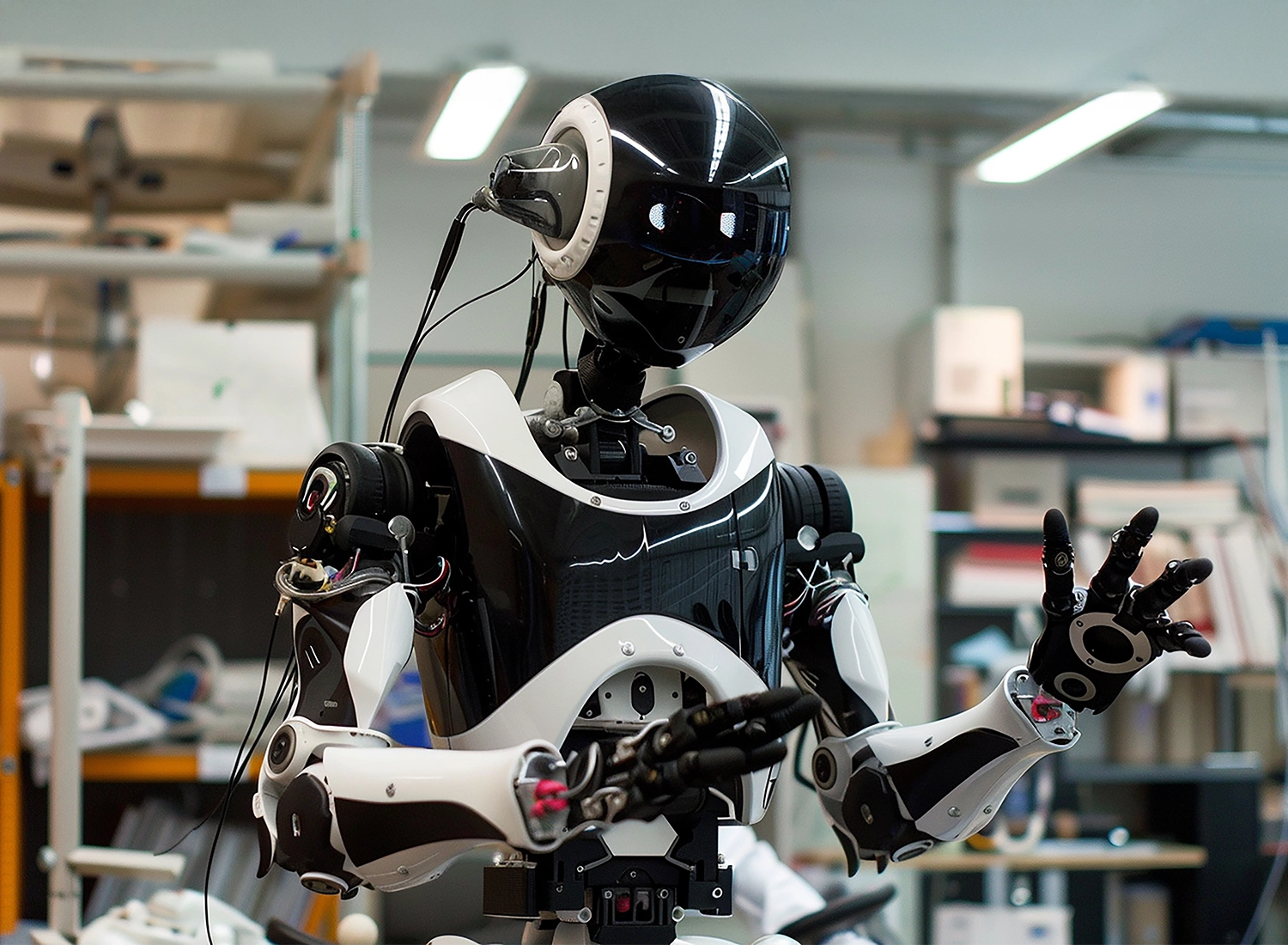
US robotics hiring in 2026 is shaped by three intersecting forces.
First, automation investment continues to broaden beyond automotive into the general industry. The Association for Advancing Automation reported 36,766 robots ordered in North America in 2025, valued at $2.25B, up 6.6% in units and up 10.1% in revenue versus 2024.
Second, the industrial robot base and deployment pace continue to climb. IFR reported 381,964 industrial robots operating in US factories, up 12%, and 37,587 units installed in 2023, still among the strongest US years on record.
Third, the market is shifting toward more intelligent, software-centric robotics. ABI Research estimates the global robotics market will reach nearly $50B in 2025 and $111B by 2030, with mobile robots as a major revenue driver throughout the decade.
For employers, this translates into a simple reality. Robotics recruiting has become a systems problem. Winning teams blend mechatronics depth, AI competence, safety discipline, and real-world deployment maturity, then package it into a hiring process that earns trust from scarce candidates.
The 2026 US Robotics Recruiting Landscape
Where demand is expanding
Robotics adoption is spreading into a wider set of environments and workflows:
- Advanced manufacturing and industrial automation, driven by investment cycles and productivity pressure
- Warehousing and logistics, where mobile robots, ASRS, and perception-heavy systems continue scaling
- Collaborative robots are pushing more robotics roles into mixed human-machine environments
- Healthcare and lab automation, where reliability, validation, and regulated operations shape hiring profiles
- Field robotics, including inspection, energy, construction, agriculture, and defense, adjacent applications
The IFR view of global industrial robotics also signals the scale context. World Robotics 2024 recorded 4.28M industrial robots operating worldwide, up 10%, with annual installations above 500k for three consecutive years.
The talent gap that US employers feel most.
US employers rarely struggle to find those who understand robotics conceptually. The real bottleneck is candidates with proven experience delivering production systems and maintaining high quality under real constraints:
- Perception engineers who have deployed on edge hardware and can own data pipelines
- Controls and autonomy engineers who can tune, validate, and debug in messy environments
- Systems engineers who integrate sensors, compute, safety, networking, and mechanical constraints.
- Robotics software leaders who can run multi-team roadmaps across simulation, tooling, and field ops
- Manufacturing and reliability leaders who know how to scale robotics hardware into repeatable builds
You also see pressure in adjacent maintenance and operational roles as robotics spreads across facilities. BLS projects that industrial machinery mechanics and related maintenance roles will grow 13% from 2024 to 2034, adding competition for electromechanical talent that robotics teams often share.
Core Roles and Competencies for Next Gen Robotics Teams
Below is a practical hiring map for 2026, organized by what actually breaks in the field.
Product and platform roles
Robotics Product Manager
Robotics Product Manager: Oversees the development and delivery of robotics products, ensuring alignment with autonomy constraints, safety requirements, unit economics, and deployment workflows through clear decision-making and risk management.
Systems Engineering Lead
Owns interfaces across mechanical, electrical, computing, firmware, safety, and networking. Often, the role that prevents costly integration failures.
Robotics Program Manager
High leverage in hardware plus software organizations, where release cadence and test readiness create cross-functional risk.
Autonomy and software roles
Robotics Software Engineer
C++, Python, ROS2 ecosystems, real-time constraints, compute profiling, logging, and telemetry.
Perception Engineer
Sensor fusion, lidar and camera pipelines, calibration, dataset strategy, and model evaluation are tied to failure modes.
Planning and Controls Engineer
Trajectory planning, MPC, state estimation, control loops, and simulation-to-real transfer.
Simulation and Tooling Engineer
Simulation and Tooling Engineer: Builds and maintains digital twins, generates test scenarios and synthetic data, and ensures continuous integration pipelines reflect field conditions.
Hardware and embedded roles
Embedded and Firmware Engineer
Real-time OS, microcontrollers, safety-critical patterns, bring-up, and reliability debugging.
Electrical and Power Engineer
Motor control, power architecture, thermal, EMI, and safety considerations.
Mechanical Engineer
Design for manufacturability, serviceability, tolerance stack-ups, and field repair ergonomics.
Deployment and scale roles
Robotics Field Engineer
Robotics Field Engineer: Acts as the main link between robotics products and customer sites, emphasizing both strong debugging skills and broad technical expertise to ensure successful deployment.
Reliability Engineer
Reliability Engineer: Leads root cause analysis, highly accelerated life testing (HALT), environmental stress testing, and develops component quality strategies to maximize system durability.
Manufacturing Engineer
Manufacturing Engineer: Designs and oversees manufacturing processes, develops test fixtures and procedures, tracks factory yield, and manages supplier integration for scalable production.
Leadership roles to plan for earlier than you think
- VP Engineering Robotics with both autonomy and hardware shipping history
- Head of Deployment and Customer Success: Oversees end-to-end deployment, blending operational management with technical expertise to ensure customer satisfaction and field performance.
- Safety and Compliance Leader: Directs regulatory strategy and ensures safety standards are embedded in processes, especially where robots interact with humans or operate in regulated environments.
Effective Robotics Recruiting Strategies for 2026
Robotics recruiting rewards process design. The goal is to reduce false positives, accelerate mutual confidence, and preserve candidate trust.
Step 1: Define the job as a performance system.
Skip generic descriptions. Build the role around measurable ownership.
- System outcomes, such as pick rate, uptime, MTBF, localization quality, or mean time to recovery
- Environmental complexity, such as lighting variance, human interaction, or terrain variability
- Constraints, such as compute budget, latency, safety certification, or supplier limitations
- Data realities, including labeling workflows, sensor failures, and logging quality
This framing attracts candidates who have lived these problems and filters candidates who have not.
Step 2: Build a sourcing strategy that mirrors the talent market.
In 2026, job boards capture a small slice of the best robotics talent. A serious sourcing plan blends:
- Targeted competitor and adjacent industry mapping
- Alumni networks from robotics labs and applied AI groups.
- Open source contribution mapping in ROS2, motion planning stacks, and simulation tooling
- Conference and community presence, including Automate and field-specific events
- Diversity outreach tied to pipeline development, mentorship, and sponsorship
A3 data showing broadening automation orders is a useful signal here. As more industries adopt robots, they compete for the same core profiles.
Step 3: Use an assessment that reflects real work
Robotics candidates disengage when interviews feel abstract. Strong assessment patterns include:
- A structured deep dive into one shipped system, from architecture to failure postmortems
- Debugging interviews based on logs, telemetry, or scenario traces
- System design anchored to constraints the team actually faces
- Collaboration interviews with hardware plus software stakeholders
- Leadership calibration using roadmap tradeoffs, safety escalation patterns, and incident response
Step 4: Use AI in recruiting, and govern it properly.
AI helps with speed and recall, especially in sourcing, resume clustering, and scheduling. It also creates governance obligations in some jurisdictions and increases scrutiny around fairness and transparency.
New York City Local Law 144 requires bias audits and candidate notices for certain automated employment decision tools used for hiring or promotion in NYC.
Federal agencies have emphasized that existing civil rights and labor expectations apply to AI-enabled employment tools, including principles of fairness and compliance.
Practical takeaway for robotics employers: treat AI recruiting tools like any other vendor risk.
- Document the tool's purpose and decision points
- Keep a human-owned decision trail for final selection.
- Audit outcomes for selection rate patterns
- Provide clear candidate communication in relevant jurisdictions.
Step 5: Close with precision
Robotics candidates choose teams as much as they choose roles. Offer acceptance rates improve when you communicate:
- Deployment plan and customer environments
- Hardware roadmap maturity and funding runway
- On-call expectations and incident ownership culture
- Data strategy and simulation maturity
- Career trajectory tied to ownership, not titles
How to Evaluate and Choose a Robotics Recruiting Partner
Robotics hiring rarely fails due to effort. It fails due to a lack of specialization, shallow evaluation, and slow iteration loops.
Partner evaluation checklist
A strong partner brings five capabilities:
- Domain fluency across autonomy, embedded, hardware, and deployment realities
- Market mapping that reaches passive candidates
- A technical evaluation model that mirrors how your team ships
- Process clarity, including timeline, calibration, and feedback loops
- Candidate experience discipline, including confidentiality and fast communication
Trends Shaping Robotics Recruiting in 2026 and Beyond
AI native robotics teams demand hybrid profiles
Perception and autonomy roles now expect strong ML literacy, data pipelines, and evaluation discipline, plus comfort with embedded constraints.
Mobile robots and logistics systems continue to attract talent.
ABI Research highlights mobile robots as a dominant revenue driver through the decade, which correlates with sustained hiring demand in navigation, fleet orchestration, safety, and reliability.
Pay transparency and hiring process transparency expand.
Pay transparency requirements continue to expand at the state and local levels in the US, influencing job design, compensation architecture, and how recruiters communicate pay ranges early.
Candidate trust becomes a competitive advantage.
Top robotics candidates screen employers hard. They ask about safety ownership, field incident culture, customer escalation patterns, and data quality. Companies that answer precisely attract stronger talent faster.
Christian & Timbers as Your Specialized Robotics Recruiting Partner
Christian & Timbers supports robotics hiring through a straightforward operating model.
1. Role calibration built on outcomes
We translate the role into measurable ownership, technical constraints, and the exact success profile that predicts impact in your environment.
2. Market mapping that reaches hidden talent
The strongest candidates often sit inside top programs, high-performing teams, and mission-critical deployments. We use relationship-driven sourcing and targeted mapping to reach them directly.
3. Data-backed evaluation that reduces risk
Robotics hiring errors show up as integration delays, reliability regressions, and field failures. Our approach emphasizes proof of shipped work, structured technical validation, and decision clarity across stakeholders.
4. Discreet execution
Robotics hiring often involves confidential roadmaps, competitive programs, and sensitive customer deployments. We operate with discretion and tight communication loops.
If you are planning a critical robotics hire in 2026, Christian & Timbers can help you define the success profile, build a targeted search, and close talent that scales with your product.
How long does robotics hiring take in 2026
For senior robotics roles, timelines typically range from 6 to 12 weeks from kickoff to acceptance, depending on interview design, candidate availability, and relocation.
What metrics define recruiting success
Useful metrics include time to shortlist, pass-through rates by interview stage, offer acceptance rate, and retention at six and twelve months. For robotics, add ramp time to the first deployment ownership.
How should companies handle confidentiality?
Use a staged disclosure approach. Share enough context to attract the right candidate, then provide deeper product and customer details after mutual interest and process alignment.
How do fees typically work with recruiting partners?
Structures vary by partner type, seniority, and scope. The best agreements align incentives around speed, quality, and process clarity.
What should candidates expect in a strong robotics interview process?
Candidates respond well to interviews grounded in real work: a shipped system deep dive, realistic debugging, constraint-based system design, and clear expectations around field support and on-call culture.
How do you support onboarding after the hire?
A strong recruiting partner stays engaged through onboarding checkpoints, stakeholder alignment, and early success planning, so the hire can achieve impact quickly.